Home
Home  Navigation



Discover why Kirby's appearance differs between the U.S. and Japan, as former Nintendo employees shed light on the strategic marketing decisions behind these changes and Nintendo's evolving approach to global localization.
"Angry Kirby" Was Made To Appeal To Wider Audiences
Nintendo Rebranded Kirby For More Appeal In The West
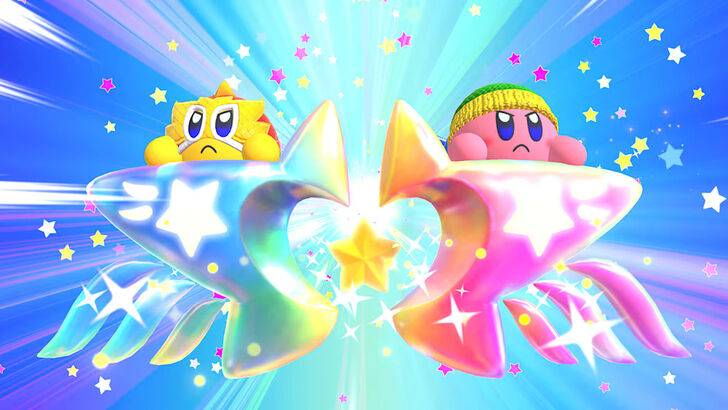
Kirby's fiercer and tougher look on game covers and artworks aimed to resonate more with American audiences, earning the nickname "Angry Kirby" from fans. In an insightful interview with Polygon on January 16, 2025, former Nintendo Localization Director Leslie Swan elucidated the rationale behind altering Kirby's appearance in the West.
Swan clarified that the intention was not to make Kirby look angry but to project determination. She stated, "Cute, sweet characters are universally adored in Japan." However, she added, "In the U.S., tween and teen boys are often drawn to more robust characters."
Shinya Kumazaki, the director of Kirby: Triple Deluxe, shared with GameSpot in 2014 that while the cute version of Kirby attracts a broad audience in Japan, a "strong, tough Kirby that's really battling hard" appeals more to American players. Yet, he noted that this varies by game, citing Kirby Super Star Ultra, which featured a tough Kirby on box art in both regions. Kumazaki emphasized that while they wanted to showcase Kirby's serious side through gameplay, the character's inherent cuteness remained a significant draw in Japan.
Advertising Kirby As "Super Tuff Pink Puff"

Nintendo's marketing strategy aimed to broaden Kirby's appeal, particularly to boys, by branding him as "Super Tuff Pink Puff" for the 2008 Nintendo DS release, Kirby Super Star Ultra. Krysta Yang, a former Nintendo of America Public Relations Manager, revealed that Nintendo sought to shed its image of being solely a "kiddie" brand during her tenure. "There was a time when Nintendo, and gaming in general, aimed for a more mature and cool image," she noted. Yang added, "Being labeled 'kiddie' was detrimental."
Nintendo consciously shifted focus to make Kirby appear more formidable and highlight the combat aspects of its games, distancing the character from being perceived as exclusively for young children. In recent years, as seen in promotional materials for Kirby and the Forgotten Land in 2022, the emphasis has shifted more towards gameplay and abilities rather than Kirby's personality. Yang commented, "There's been an ongoing effort to develop Kirby into a more versatile character, though most still see him as cute rather than tough."
Nintendo’s U.S. Localization For Kirby
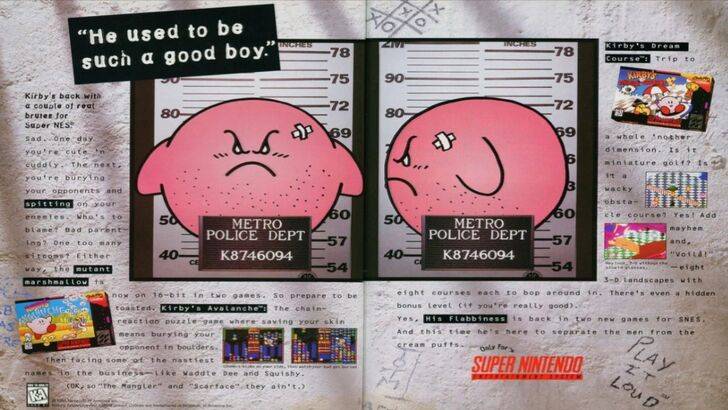
The divergence in Kirby's localization between Japan and the U.S. began with a notable 1995 print ad featuring Kirby in a mugshot as part of Nintendo’s "Play It Loud" campaign. Over the years, Kirby's box art varied, with titles like Kirby: Nightmare in Dream Land (2002), Kirby Air Ride (2003), and Kirby: Squeak Squad (2006) showcasing him with sharp eyebrows and stern expressions.
Beyond facial expressions, Nintendo made other adjustments to Kirby to appeal to Western audiences. For instance, the U.S. box art for the 1992 GameBoy release, Kirby's Dreamland, depicted Kirby with a ghostly-white tone instead of his traditional pink hue, due to the GameBoy's monochrome display. This color change became evident only when Kirby's Adventure was released on the NES in 1993. Swan remarked, "A puffy pink character wasn't appealing to boys trying to be cool, which impacted sales."
Consequently, Nintendo of America modified Kirby's facial expressions on U.S. box art to broaden the character's appeal. In recent times, Kirby's global advertising has become more uniform, alternating between serious and cheerful expressions.
Nintendo’s Global Approach
Both Swan and Yang noted that Nintendo has adopted a more global perspective in recent years. Nintendo of America now collaborates more closely with its Japanese counterpart to ensure consistent marketing and localization strategies. The company aims to move away from regional variations, such as those seen in Kirby's earlier box art and the 1995 "Play It Loud" advertisement.
Yang explained, "The shift to global marketing was a strategic business move. It's beneficial for brand consistency across regions, but it can sometimes overlook regional differences." She expressed concern that this might result in "bland, safe marketing" for some of Nintendo's products.
Game localizers attribute the current trend of more uniform localization to the industry's globalization and the increased exposure of Western audiences to Japanese culture through games, movies, manga, anime, and other media.
 Latest Articles









 Latest Games